.webp) h5gamehot.com
h5gamehot.comThe Other Half of the Screen: Why Aion 2 Keeps Its Enemy Out of Sight
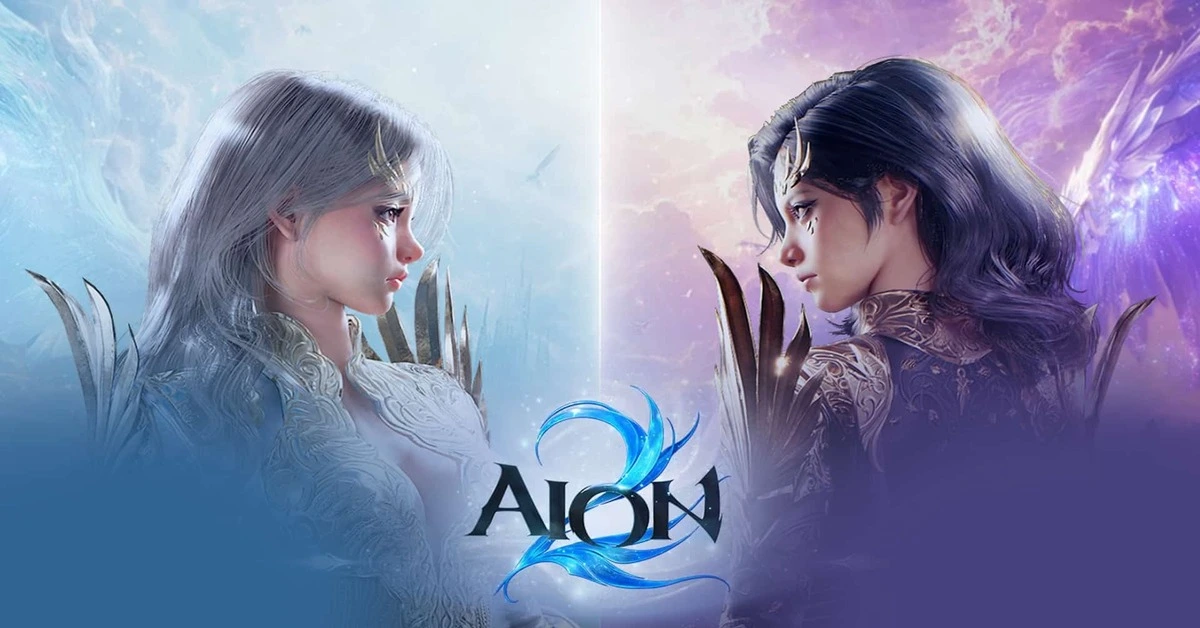
The key art for Aion 2 is built around a single vertical line. On the left, a silver-haired Elyos in pale blue light. On the right, a dark-haired Asmodian washed in violet. They face each other in profile, close enough to touch, and yet the image never lets them occupy the same space. The line between them is not decoration. It is the most honest summary of how the game is structured. Most MMORPGs that promise a faction war put both sides in the same world and trust that conflict will emerge from proximity. Aion 2 does something stranger and more deliberate. It separates the two factions onto different servers, lets them meet only in the Abyss and in a few designated flashpoints, and builds its entire sense of rivalry on the idea that an enemy you rarely see becomes more present in your mind, not less.
That choice runs against a lot of genre instinct. We tend to assume that more contact means more drama, that a war feels real when the other side is visible at every crossroads. But anyone who has spent years in a faction-based MMO knows how that usually goes. The enemy becomes furniture. You ignore a red nameplate the way you ignore a vendor, and the ambient hostility that was supposed to charge the world dissolves into low-grade noise. Players learn the safe routes, the quiet hours, the zones where the other side never bothers to go, and the war quietly becomes a set of habits rather than a story. Aion 2 is built on the opposite bet: that scarcity creates meaning. If the other faction is somewhere you have to go, rather than something you bump into, then going there becomes an event, and everything that happens on the way, the preparation, the nerves, the sense of leaving your own people behind, becomes part of the experience rather than dead time before it.

A War You Have to Travel To
The setting gives this structure a story to hang on. Aion 2 takes place two hundred years after the original game, following the destruction of the Tower of Eternity, the structure that once anchored the world of Atreia. The Elyos and the Asmodians, who spent the first game fighting across a split sky, now live in a shattered universe where the old geography no longer works, and a newly empowered Balaur dragon faction presses in on both of them. Narratively, the separation of the two peoples is not a technical convenience dressed up as lore. It is the consequence of a broken world, and the game’s structure echoes that brokenness at the level of how players actually meet.
In practice, the two factions are kept on separate servers within each regional cluster, and your faction choice is locked in on a given server. Contact happens in the Abyss, the game’s principal PvPvE zone, and through matchmaking and invasion-style events rather than through casual overlap in the open world. That is a very different rhythm from a persistent shared map where the enemy might appear over any hill. Instead of the war being a constant, you experience it in bursts, and the space between those bursts is where much of the game’s atmosphere lives. A few things follow from this:
- Your own side feels like a community. Because the other faction is not wandering through your hubs, towns and questing zones can be treated as shared home territory rather than contested ground.
- Entering the Abyss feels like crossing a border. The shift from a cooperative, relatively safe world to a place where the other half of the screen is waiting changes the emotional register of play on its own, before a single skill is used.
- Choosing a faction carries real weight. If you cannot freely cross over, the decision at character creation is closer to choosing a nationality than choosing a costume.
None of this is accidental. A studio that wanted constant open-world skirmishing would not have built it this way. The structure is designed to make conflict rarer so that it can be more charged, and the whole identity of the game rests on whether that trade pays off.
Flight as the Language of Distance
The second half of the argument is vertical. Aion has always been the MMORPG where flight is a core verb rather than a travel convenience, and Aion 2 extends that tradition into a world NC describes as roughly thirty-six times larger than the original’s, with aerial movement woven into both PvE and PvP. It is tempting to read flight as pure spectacle, wings and cloudscapes and sweeping vistas, and it is certainly that. But in the context of a divided world, flight does something more specific. It makes distance feel traversable and dangerous at the same time.
A world you can only cross on foot is a world of fixed routes, where the enemy is whoever happens to be on the road. A world with real vertical freedom is a world of approach angles. You do not simply arrive in the Abyss. You come in from above, from below, around a rock formation, with the sky as a tactical space rather than a backdrop. This matters for the separation thesis because it gives the rare encounters between factions a sense of geometry. When you finally cross paths with someone from the other side, the fight is not just a collision. It is the end of an approach, and approaches are where a great deal of the tension in PvP actually lives. Anyone who has stalked a target through a canyon, or circled a fortress deciding which side to hit, knows that the moments before the fight are often more memorable than the fight itself.
The combat supports that feel. NC pitches Aion 2’s fighting as a blend of precision, timing, and positioning layered over traditional tab-targeting, which means that engagements are not purely a matter of spreadsheet efficiency. Where you are, which way you are facing, and what you are chaining together all matter, and that physical awareness is exactly what a game about rare, high-stakes encounters needs. A system where positioning is irrelevant would flatten the drama of meeting the enemy. A system where it matters turns each encounter into a small problem with a physical shape, something you can win through awareness as well as numbers.
The Abyss and the Value of a Meeting Place
If separation is the thesis, the Abyss is the argument’s proof. A game that keeps its factions apart needs somewhere for them to meet, and that somewhere has to justify the entire structure. If the meeting place is dull, the separation feels like an obstacle. If it is charged, the separation feels like a build-up. The Abyss is positioned as that charged space: a PvPvE zone where the factions collide, but where the environment and its monsters also have a say in how those collisions play out.
The “PvE” half of that label does more work than it first appears to. A zone where both factions are fighting each other and the world at the same time cannot be reduced to a pure duel. Attention is split. A group that wins a skirmish may be left exposed to a threat that neither side controls, and a retreat can be as costly as a defeat. That three-way pressure is what keeps the Abyss from becoming a simple arena, and it echoes the larger narrative situation, in which two peoples who should be rivals are also caught in a world that is trying to destroy both of them.
This is also where the launch-era decisions about scale become interesting. The global version has been described as launching without large-scale siege warfare, with PvP centered on smaller arenas and objective-based battles. That is a restrained opening, and whether it satisfies players who remember the original game’s fortress sieges is an open question. But there is a design logic to it. A structure built on rare encounters benefits from encounters that feel personal, where a group of players can recognize each other’s tactics, remember a close loss, and want a rematch. Smaller-scale PvP gives the separation thesis room to breathe, even if it leaves the grandest expression of the faction war for later.

Legions: The Society Behind the Line
A divided world also changes what a guild is. Aion’s Legion structure carries over into the sequel, and in a game where the enemy is mostly absent, the Legion becomes more than a chat channel and a loot-sharing arrangement. It becomes the main unit of belonging, the people you prepare with before you cross into the Abyss and the people you return to afterward.
This is a quieter consequence of the separation, but it may be the most important one for long-term engagement. In a game where both factions share every zone, the war is something that happens to you, and communities are formed partly in reaction to constant pressure. In a game where the war is something you choose to enter, the community has to give you a reason to go. Raids, events, and coordinated pushes become shared rituals, and the Legion becomes the place where the war gets its meaning, not just its logistics. The enemy may be far away, but your own people are always close, and that proximity is what turns a faction into something you actually care about.
It also changes the texture of ordinary play. The dungeon content, which NC says spans over two hundred instances across solo, four-player, and eight-player formats, is not just a side activity in this structure. It is the daily life of the faction, the shared work that makes the occasional trip to the Abyss feel earned. A Legion that spends the week clearing raids together arrives in the contested zone with a story, and stories are what make rare encounters resonate. The separation does not just reduce contact with the enemy. It concentrates attention on the people you are fighting beside.
Eight Ways to Be on Your Side
The class structure reinforces the same idea from the inside. Aion 2 launches with eight classes that cover the familiar spread of roles: Gladiator, Templar, Assassin, Ranger, Sorcerer, Elementalist, Cleric, and Chanter. Every character begins as an Adventurer before specializing, and each class carries its own chains of skills and its own place in group content and PvP. A ninth class, the Fist Master, was revealed at a summer showcase, though its availability at global launch was not confirmed at the time of the announcement.
What matters here is not the roster itself but what a faction-segregated structure does to class identity. In a game where both sides share a world, class balance becomes a constant argument, with every Elyos Sorcerer implicitly measured against every Asmodian one in the same field at the same hour. In a game where the factions meet in controlled environments, class identity can be built around what a role offers your own community first, with balance tuned around the structured places where the sides actually clash. The tank is valued for raids and organized groups. The healer is valued for what they make possible. The assassin is valued for how they change the shape of those rare cross-faction fights. Each class has a job inside a society before it has an opponent.
That distinction sounds small, but it changes how a player relates to their own role. Playing a Cleric in a world where enemies are always visible can feel like permanent triage. Playing a Cleric in a world where the enemy is a place you travel to can feel like preparing for an expedition, with all the planning, supply-gathering, and quiet anticipation that implies. The same character, in a different structure, becomes a different kind of story.
The Third Party in the Mirror
It would be a mistake to treat the Elyos and Asmodians as the only forces that matter, because the Balaur complicate the mirror in an interesting way. They are an NPC-only faction, a powerful dragon people who return as the principal antagonist and who press on both of the playable sides. In a design built around two mirrored factions, a shared enemy does something subtle: it reminds the player that the rival across the line is not the only threat, and that the war between light and dark is happening inside a larger crisis.
That matters for the emotional balance of the separation. If the Elyos and Asmodians were simply two armies eyeing each other across a border, the structure would risk feeling like a sports fixture, two teams, one scoreboard. The Balaur turn it into something more uneasy. The other faction is a rival, but it is also a fellow survivor, and the knowledge that both sides are living under the same shadow gives the occasional clash a faintly tragic quality. You are fighting someone who is, in a deeper sense, in the same situation as you. The mirror image on the key art starts to look less like an enemy and more like an alternate version of the self, and that ambiguity is exactly the kind of tension a separated-faction design is capable of producing.
Where Separation Strains
It would be dishonest to present this structure as a clean solution, and the strain points are worth naming. The first is population. Separating factions onto different servers means that each community has to be healthy on its own terms, and a global launch is a cold-start problem for exactly that reason. If one faction’s servers fill faster than the other’s, the meeting-in-the-Abyss fantasy depends on both sides showing up in comparable numbers, which is something a design document cannot guarantee. The rarity that makes encounters meaningful can curdle into emptiness if one side is simply absent, and an enemy who never shows up is not mysterious, only missing.

The second is scale and variety of conflict. A launch without siege warfare, with PvP concentrated in smaller arenas and objective battles, is a sensible opening, but it also means that the most dramatic expression of a faction war is not part of the opening picture. The separation thesis works best when the rare encounters carry real stakes, and smaller-scale PvP may feel like a gentler version of that promise until more content arrives. Players will be watching closely to see whether the contested spaces grow in ambition or remain, in practice, a series of well-made but contained skirmishes.
The third is permanence. A faction choice that is locked to a server is a strong identity statement, and also a potential regret. Players who pick a side based on a screenshot and discover that they would have preferred the other may find that the wall between the factions is firmer than they expected. Server transfer services exist in the Korean version, and NC has said it is committed to bringing one to the global release, but the details and pricing for global players have not been announced. A structure that depends on commitment needs a plan for what happens when commitment turns out to have been a mistake.
The fourth, and the one that will be judged over months rather than days, is monetization. The global version has been described as free-to-play with a cosmetic-focused cash shop, an optional subscription, and an optional battle pass, alongside paid Founder’s Packs that include early access. Cosmetic-only monetization is a sensible stance for a game selling the idea of faction identity, since it keeps the war from becoming a wallet contest. But promises like that are tested slowly, and a design built on belonging will be especially sensitive to any sense that belonging is for sale.
What Aion 2 Is Betting On
The global launch arrives on a clear timeline: five days of early access for Founder’s Pack buyers beginning September 30, and a free-to-play opening on October 5 on PC through Steam and NC’s own launcher. The Korean and Taiwanese versions, which have been live since November 2025, drew one of the biggest MMORPG debuts in recent memory, so the structure is not an untested theory. It has an audience that has already lived with it. What the global release tests is whether that same sense of divided space translates to a market with different expectations about what a faction war should feel like, and whether Western players will embrace a design that asks them to treat the enemy as a destination rather than a neighbor.
If it does, the reason will be the idea that opened this piece. A war that is always in your face teaches you to stop seeing it. A war you have to travel to, across a broken sky, toward a place where the other half of the screen is waiting, keeps its power because it keeps its distance. Aion 2 is built on the belief that rivalry needs a border to mean anything, and that a line down the middle of the world can be the most dramatic thing in it. Whether that belief survives contact with a few million players is the real question of this launch, and it is a far more interesting one than whether the wings look good.